Newborn bedding
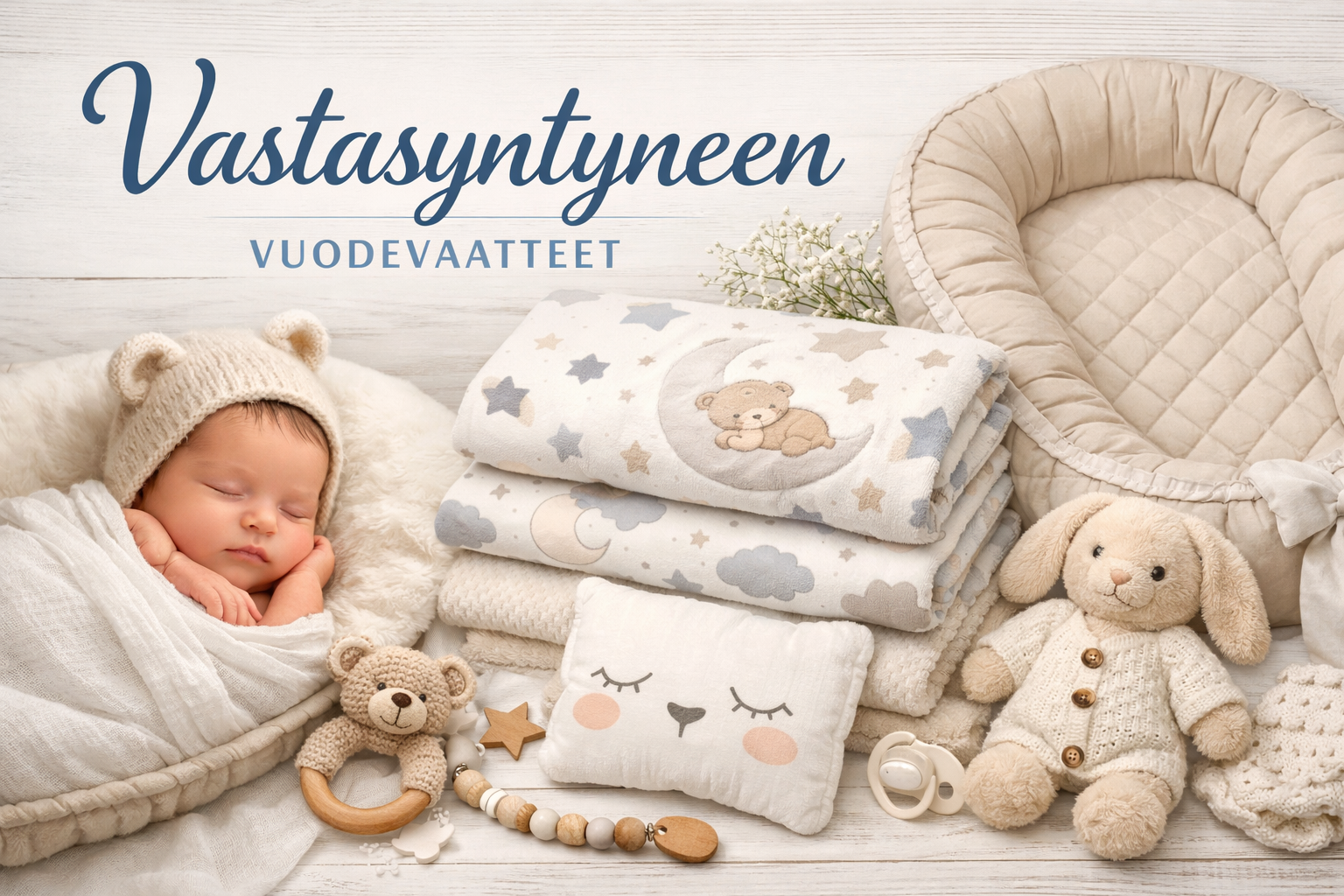
When buying bedding for a newborn, it is tempting to prepare for everything. Yet the safest and often easiest solution is surprisingly simple: a firm mattress, a well-fitting sheet, and a lightweight duvet or sleeping bag suited to the baby’s warmth needs. When the bed is simple, it is easier for the baby to sleep and for the adult to assess whether the conditions are suitable.
Safety comes from small details. Breathability, the right size and materials safe from harmful chemicals are usually more important than a trendy pattern or plush softness.
What does a newborn really need?
A newborn does not need many of the things often seen in baby photos in their own bed. Pillows, soft toys, thick duvets and cot bumpers increase the risk of suffocation if the baby’s face presses against them. They can also trap heat and increase the risk of overheating.
In most homes, a practical basic set looks like this: a mattress, 1–2 fitted sheets (or a flat sheet that can be tucked in very securely), and either a lightweight baby duvet or a suitably sized sleeping bag. That is all.
In everyday life, the most important thing is that the textiles can be washed at a sufficiently high temperature and often enough, and that there are enough spare textiles without constant laundry.
A safe bed: basic principles that go a long way
It is worth thinking of the bed as “free space”. When the bed contains only what is necessary, the baby’s movement, breathing and temperature regulation are not disturbed. The fit of the mattress and textiles is essential: if the mattress is too small or the sheet is loose, folds and gaps can form.
A good rule of thumb is that there should be no gap wide enough for fingers between the cot mattress and the sides. The sheet should fit snugly and stay in place even when the baby moves.
For a quick checklist, these are the points that are most useful:
- A firm mattress
- A well-fitting sheet
- A bed free of unnecessary items
- A lightweight duvet or sleeping bag
- Baby sleeping on their back
If any detail feels uncertain, the better solution is usually to reduce items rather than add them.
Materials and certifications: what is suitable next to the skin?
A baby’s skin is thin and sensitive, and textiles are in direct contact with it for long periods. This is why material choice is a matter of both comfort and safety. Breathable natural fibres are generally a safe starting point.
Cotton (including percale) works year-round in many homes: it is breathable, feels pleasant and withstands repeated washing. Linen is excellent for temperature regulation, but may initially feel firm to some. Bamboo viscose is often very soft, but production methods vary, which makes certifications especially important. Wool is often used in temperature-balancing intermediate layers or blankets, but it is not always the best choice directly against sensitive skin.
For chemical safety, a certification is a practical aid. OEKO-TEX® Standard 100 indicates that the textile has been tested for harmful substances. In organic products, GOTS certification communicates criteria for both the raw material and manufacturing. If there is atopy or a tendency towards allergies in the family, the Allergy Symbol is also an easy way for many to narrow down their choices.
Below is a concise comparison to help you choose a sheet and cover material:
Material |
Benefits for a newborn |
Points to consider |
|---|---|---|
Cotton (including organic) |
Breathable, easy to wash, durable |
Choose a firm weave and a good fit |
Percale cotton |
Cool, dry feel, smooth against the skin |
Many find it best for warm rooms |
Linen or cotton-linen |
Excellent temperature regulation and breathability |
Softens with use; initially firm |
Bamboo viscose (high-quality) |
Very soft, often pleasant against the skin |
The manufacturing process varies; certifications are useful |
Polyester and fleece |
Inexpensive and “plush” |
Less breathable; may trap heat and moisture |
Material alone does not determine everything. The weave, finish and wash durability also affect how safe and easy a textile is in everyday life.
Duvet or sleeping bag?
Safe covering for a newborn is one of the most common questions. A lightweight duvet can work well when it is appropriately sized and the room temperature remains stable. A sleeping bag is easier for many: it stays on, does not rise over the face and makes dressing more straightforward when “the duvet does not wander”.
Size is important when choosing a sleeping bag. A model that is too large can ride upwards, while one that is too small can be restrictive. The neckline and armholes must be suitable so that the baby cannot slip down inside the bag. The same material principles apply as for other textiles: breathable and pleasant against the skin.
If a duvet feels more natural, choose a thin and lightweight one rather than a thick, plush one. A thick duvet can trap heat, and a young baby’s temperature regulation is still developing.
Many find it helpful to decide according to the seasons: in summer, a thin sheet and a lightweight sleeping bag or just a sleepsuit; in winter, a warmer sleeping bag and layered clothing.
Mattress, sheet and protectors: fit is key
The mattress is central to a baby’s sleep. It must be firm and the right size for the bed. A mattress that is too soft can increase risks, and one that is too small leaves dangerous gaps at the edges.
For sheets, a fitted style (with elasticated corners) makes it easier to achieve a snugly made bed. If you use a regular flat sheet, it must be tucked in especially carefully and secured so it cannot loosen.
It is worth being careful with mattress protectors. A completely plastic, non-breathable moisture protector can block airflow and is a poor choice for a baby. If protection is needed, a breathable and washable solution is better, one that does not make the surface plastic-like or slippery. When comparing options, look for information on breathability and washing temperature.
Two questions help here: “Can air circulate?” and “Does the surface stay firm without folds?”
Washing and everyday care: freshness without unnecessary chemicals
New textiles should be washed before first use. This removes residues left on the fabric during manufacturing and storage, and softens the feel. Practicality also matters when washing: baby sheets and duvet covers are washed often.
A good basic approach is detergent without fragrances or colourants, and avoiding fabric softener. Many baby textiles withstand washing at 60 °C, which is useful for hygiene as long as the manufacturer’s instructions allow it. Drying should be done so that the textile dries fully and remains fresh.
To make everyday life easier, the practical number of bedding items is often smaller than you initially think, as long as they are easy to change. If there are too few sheets, laundry piles up. If there are a great many, extra items accumulate in cupboards.
For a practical guide, these are suitable starting quantities for many, which can be adjusted according to your own laundry routine:
- Fitted sheets: 2–4 pieces
- Duvet covers or blanket covers: 1–3 pieces
- Spare duvet or sleeping bag: 1 piece, if washing intervals are frequent
If there is a lot of reflux or spit-up in the family, sheets may need changing more often, and spare items are usually more useful.
Warmth and layering: bedding is not solely responsible
For a baby’s sleep, bedding and clothing form a whole. If the room is warm, a thick duvet is usually not needed. If the room is cool, layered clothing and a temperature-balancing, breathable cover often work better than one heavy layer.
A practical way to assess the baby’s warmth is to feel the back of their neck or upper back: if the skin is sweaty, there are too many layers; if it feels cool, extra warmth may be needed. Hands and feet may feel cooler without the baby being cold.
A hat is generally not needed when sleeping indoors, and it can increase the risk of overheating. The same thinking can be applied to “just-in-case duvets”: it is better to adjust room temperature and layers than add items to the bed.
How do you recognise a quality set when buying online?
When shopping online, choices are made based on product descriptions and images, so it is worth setting out clear criteria for yourself. In addition to the material, check whether certifications, washing temperature and dimensions are mentioned. For baby textiles, “machine washable” alone does not say enough; temperature and drying ability matter greatly.
A useful way to structure your purchase is to divide the criteria into three categories: safety, care and usability. This way, a single pattern will not lead the decision in the wrong direction.
- Safety: snug fit, breathable material, certification
- Care: the possibility of washing at 60 °C or clear washing instructions, quick drying
- Usability: suitable dimensions for your own bed, easy to change
If you are ordering for the first time, a flexible right of return and easily reachable customer service reduce the risk of unsuitable purchases. Many also appreciate that delivery is handled by a reliable carrier and is insured, because baby essentials are often needed by a certain date.
When the bed is simple and the textiles are breathable and well-fitting, everyday life becomes easier surprisingly quickly. The focus can then remain on what matters: the baby can sleep peacefully, and parents can have as clear a routine as possible for evenings and nights.
