What kind of sheet is suitable for an adjustable bed?
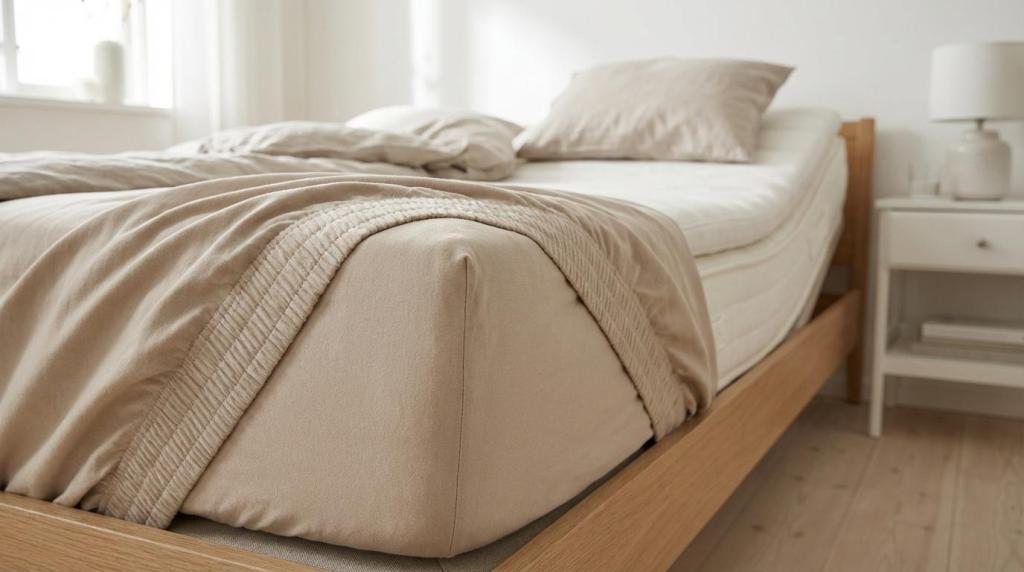
An adjustable bed quickly feels luxurious in everyday life when you can adjust the head and foot ends for reading, recovery or getting up more easily. The same movement also reveals one practical issue: an ordinary sheet does not always stay in place, but starts to roll up, tightens at the corners or slips off the mattress.
The good news is that a sheet suitable for an adjustable bed is no mystery. When the dimensions, material and fastening are right, the sheet stays neat even when the frame bends and the mattress changes shape.
What makes sheets challenging on an adjustable bed?
In an adjustable bed, the mattress is not just a “base”; it moves. When you raise the head end, the sheet is pulled at the upper corners and in the middle. When you raise the foot end, the sheet tends to slide towards the feet and easily forms folds around the knee area.
Three things affect how well it stays in place: the sheet’s stretch, the depth of the fitted pocket and the quality of the elastic. If even one of these is wrong, the movement of the bed makes the problem apparent.
Many notice the difference only at night, when the sheet feels tight against the skin or starts to “gather” in the middle.
Measure correctly: width, length and mattress height
Mattresses in adjustable beds are often thicker than those in standard bed frames, and they may have a separate mattress topper. In that case, the sheet needs a deeper fitted pocket than usual.
When measuring, include:
- mattress width and length
- mattress height
- mattress topper height (if used)
- whether the bed has one continuous mattress or two separate ones (e.g. 2 x 80 cm)
The following is a practical checklist before buying, especially if the sheet is a “pocket sheet”, i.e. fitted:
- Mattress height: choose a fitted pocket that is generously sized rather than tight
- Elastic: elastic running around the entire edge usually stays in place better than elastic only at the corners
- Bed structure: separate sheets for two separate mattresses or a flexible “split” solution helps if the head ends are adjusted to different positions
Which type of sheet works best?
For an adjustable bed, the best basic choice is usually a fitted sheet with a deep fitted pocket and firm elastic. A flat sheet requires folding and “locking” the bed making in place, and movement easily loosens the folds.
If the mattress is particularly high or has a slippery surface, sheet straps (crossing straps that pull from corner to corner) can be used under the sheet. They are not essential, but they are a quick solution if you want to use sheets you already have.
Materials for adjustable beds: what is the real difference?
Material determines two things: how the sheet stretches with movement and how it feels against the skin. The five options below are common, and each has its own strength.
Cotton (percale and other woven cottons)
Woven cotton is highly breathable and withstands washing. It is a safe, easy basic choice, but it does not stretch in the same way as knits on an adjustable bed.
If you like a crisp, “hotel-like” feel, cotton may be exactly right for you. In that case, it is worth investing in a deep fitted pocket and firm elastic, as the fabric does not give with movement.
One practical observation: if the mattress cover is very smooth (or the mattress topper moves easily), a cotton sheet tends to slip more readily than a stretchy knit sheet.
Cotton sateen
Cotton sateen is also woven cotton, so stretch is not its main advantage. Its benefit is its feel: a smooth, soft surface weave that many find cool to the touch.
In an adjustable bed, cotton sateen works when the dimensions are snug and the fitted pocket is high enough. If you do not want the “T-shirt-like” feel of knit fabric, sateen is a good middle ground between basic cotton and a stretchy jersey sheet.
It is still worth noting that the smooth surface may be slightly more slippery, so the fit of the elastic and pocket becomes particularly important.
Double jersey
For many, double jersey is the easiest choice for an adjustable bed because it stretches and returns to its shape. The knit “moves” with the mattress and is less likely to tighten when the head and foot ends are raised.
It is also often thicker and more substantial than thin jersey, which helps it stay in place. In return, it may feel warmer if you already sleep hot.
If the aim is as carefree an everyday experience as possible, double jersey is a strong option.
Molton (molleton)
Molton is not typically an actual top sheet, but rather a mattress-protector-like layer. It is thick and absorbent, and is often used to protect the mattress from moisture and wear.
In an adjustable bed, the idea of molton is layering: molton protects the mattress, and a pleasant top sheet is placed over it for a comfortable feel against the skin.
If you want to reduce the moisture reaching the mattress or extend its lifespan, molton is sensible. However, it may add warmth because its thick construction retains more heat than a thin sheet.
Waterproof TPU (in mattress protectors)
TPU generally refers to a mattress protector with a waterproof membrane beneath the textile. It is not “sheet-like in feel” in the same way as cotton or jersey, but a protective layer with a regular sheet placed on top.
For an adjustable bed, it is important to choose a protector with a flexible construction and a membrane designed to be breathable. Otherwise, the surface may feel stuffy.
TPU is particularly suitable for families with children, homes with pets or situations where a mattress protector provides everyday reassurance.
Comparison table: which material is suitable for what?
Material |
Stretch in an adjustable bed |
Feel against the skin |
Stays in place without additional fastenings |
Best use |
|---|---|---|---|---|
Cotton |
Poor |
Crisp, fresh |
Depends on pocket depth |
Top sheet when the dimensions fit |
Cotton sateen |
Poor |
Smooth, soft |
Depends on the elastic |
Top sheet when you want smoothness |
Double jersey |
Very good |
Soft, stretchy |
Often good |
Everyday top sheet when the bed is adjusted frequently |
Molton |
Poor (the fabric does not stretch) |
Rougher, thick |
Moderate as a protective layer |
Base layer for mattress protection |
TPU (waterproof) |
Varies by construction |
Protective |
Good as a protector, not as a top sheet |
Base layer when waterproofing is needed |
Layered bed making works: when you want both comfort and protection
Many choose two layers for an adjustable bed because this offers both a good feel and peace of mind. A common structure is: mattress, protective layer, top sheet.
When considering layers, combinations such as these have worked well in practice:
- For sweating: molton underneath, breathable cotton or cotton sateen on top
- For frequent adjustment: stretchy double jersey on top, with a thin protective layer underneath if needed
- When protection is needed: TPU protector underneath, stretchy sheet on top so the surface feels pleasant
Keeping it in place: pocket depth, elastic and accessories
An adjustable bed quickly reveals whether the elastic is weak. Good elastic runs around the entire edge of the sheet and continues to grip the mattress even when the sheet stretches with movement.
If you otherwise like the sheet but it comes off at the corners, a small addition often helps: sheet straps or corner clips hold the sheet “crosswise” underneath the mattress. They are especially worth using with woven cottons and sateen if the bed is used heavily.
One point to note: if the mattress topper moves on the mattress, the problem is not always the sheet. A non-slip mat between the topper and mattress stabilises the whole setup.
Washing and care: keeping the stretch and protective membrane in good condition
In an adjustable bed, sheets are stretched more than usual, so care is also particularly important. Elasticated edges in particular wear out faster if washing is too hot or tumble drying is harsh.
A good rule of thumb is to wash stretch sheets at a moderate temperature and avoid fabric softener if you want a long lifespan.
The following instructions help in everyday life:
- Stretch knit sheets: 30–40 °C and a gentle cycle to preserve elasticity
- Woven cottons and cotton sateen: 40–60 °C is often suitable, but check for shrinkage allowance and reshape while damp
- TPU protectors: cool or warm wash, no bleach or fabric softener, no hot drying
What should you check in an online store before ordering?
A beautiful sheet always looks suitable in a product image, but for an adjustable bed it is worth reading the product details more carefully than usual: fitted pocket dimensions, recommended mattress height, material and elastic construction.
Many also value textiles made from safe materials. In bedding, OEKO-TEX certification is a practical way to ensure that a product has been tested for harmful substances.
If this is your first sheet for an adjustable bed, a flexible right of return makes it easier to try one, because the fit and feel only become clear in use. Fast customer service is also useful if you are unsure about the mattress height or correct size.
A small example: when do I choose which?
If the bed is adjusted every evening, I usually choose a stretchy option. Double jersey or another stretchy knit makes everyday life easier because it stays neat with less effort.
If coolness and a crisp feel are most important, I choose woven cotton or cotton sateen and make sure the fitted pocket is genuinely deep enough. If necessary, I use sheet straps.
If there is a need for protection at home, I make the bed in layers: TPU or molton underneath, with a comfortable sheet on top. This approach works surprisingly well in an adjustable bed, as long as the top sheet is stretchy and the dimensions are snug.
