Mattress Protector Size and Fit – Measuring Guide
A mattress protector is one of those household purchases whose value is often noticed only after something has already happened. Sweat, small accidents, dust and everyday wear may not be visible immediately, but they can easily remain in the mattress for a long time. That is why the size of the protector is not a minor detail: it directly affects how well the mattress stays clean and how comfortable the bed feels in use.
Many people only look at the width and length of the mattress. That is a good start, but it is not enough. In many situations, it is the height, or pocket depth, that determines whether the protector stays neatly in place or starts lifting at the corners, pulling too tightly or gathering wrinkles beneath the sleeper.
Why does fit matter so much?
A well-fitting mattress protector does its job unobtrusively. It stays in place, does not slip during the night and does not unnecessarily change the feel of the mattress surface. When the protector follows the mattress shape evenly, the protection works as it should too.
A protector that is too small is a common problem. It may initially look suitable, but in use the corners start to lift, the edges pull and the fabric becomes tight. This can leave part of the mattress unprotected. At the same time, the sleeper often feels extra tension or folds beneath the sheet.
A protector that is too loose creates a different kind of problem. When the fabric remains slack, it moves more easily, wrinkles and may feel unsettled, especially when changing sides. The protection is then less secure, and comfort suffers.
Even a small fitting error can therefore be noticeable every night.
Three measurements that determine the right size
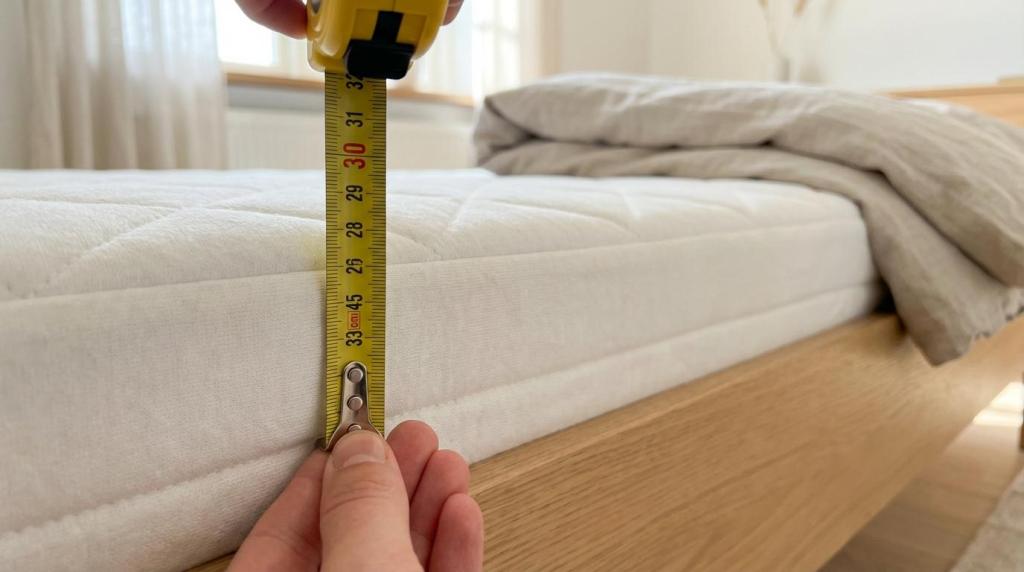
Choosing a suitable protector starts with a tape measure. Measure the mattress width, length and height directly from the mattress, rather than estimating based on the bed frame or the size of an old sheet. If you use a thick mattress topper and the protector goes around it, include it in the measurement as well.
Measuring is quick when you always proceed in the same order.
- Width: measure from side to side at the widest point of the mattress
- Length: measure from the head end to the foot end
- Height: measure from the bottom of the mattress to the top surface, including any mattress topper if the protector goes around both
Height is surprisingly often left unchecked. This is where most mistakes are made, especially with thick foam mattresses and continental beds. For example, if the mattress is 160 x 200 cm but 30 cm high, a standard protector made for a low mattress may not fit well even if the other two measurements are correct.
It is also worth measuring the mattress in more than one place if the edges are rounded or the structure is soft. In some mattresses, the middle and edges are not exactly the same height.
Pocket depth is the most common pitfall
The pocket depth of a mattress protector indicates how thick a mattress it is designed for. If the product information states that the protector is suitable for mattresses up to 27 cm high, treat this as a clear limit. A little stretch helps, but it does not compensate for a structure that is too shallow.
Thicker mattresses need more room, especially at the corners. Memory foam, latex and generous surface padding often make a mattress higher than older basic spring mattresses. That is why the same nominal size does not automatically mean the same fit.
The table below makes it easier to understand which type of protector suits different mattress types.
|
Mattress type |
Typical height |
What to look for in a protector |
|---|---|---|
|
Basic spring mattress |
15–22 cm |
A standard pocket depth is often sufficient |
|
Memory foam mattress |
20–30 cm |
Generous pocket depth, good stretch at the edges |
|
Latex mattress |
18–28 cm |
Breathable material, sufficient height allowance |
|
Continental bed mattress |
20–35 cm |
Deep pocket, careful height measurement |
|
Mattress topper |
5–10 cm |
A separate shallow protector or a dedicated protector for the mattress topper |
|
Two mattresses in an adjustable bed |
varies |
Two separate protectors often work best |
If you are between two options, a slightly roomier but suitable pocket is often a safer choice in terms of height than a model that is too tight. However, it is still important that the protector does not remain loose on the top surface.
The protector style also affects the fit
Not all mattress protectors sit on the mattress in the same way. The most common style resembles a fitted sheet: the top surface protects the mattress, while a side skirt or elasticated edge keeps the protector in place. For many, this is the easiest everyday solution because it is quick to put on and remove for washing.
Another option is a zippered encasement protector that encloses the mattress almost completely. It is well suited to situations where protection is also wanted for the sides and underside. This type is useful when the bed needs closer-than-usual protection against dust, allergens or repeated accidents.
When considering the style, use matters much more than the price alone.
- for everyday use and quick changes
- for homes with children and pets
- for sleepers who sweat easily
- for situations where side protection is also important
If the protector is washed frequently, ease of fitting becomes surprisingly important. Many then choose a model that can be removed and put back on without lifting the mattress with two people.
Material feels more important than many think
Size and fit matter a great deal, but the material completes the user experience. A waterproof protector does not automatically mean a stuffy or rustling surface. Modern options often use a TPU or PU membrane, which prevents liquids from reaching the mattress while allowing moisture vapour to escape more effectively than a traditional dense plastic layer.
The surface fabric matters just as much. A cotton surface feels natural and soft to many. Microfibre can be smooth and quiet. Bamboo or other moisture-wicking blends are particularly interesting when the aim is a cooler feel. If the sleeper sweats heavily, breathability should be a high priority when choosing.
The cheapest possible solution may look good on paper, but small differences become major over the course of a night. If the protector rustles, slips or retains heat, you may not want to use it in the end, even if the protection itself is adequate.
How to read product information without guessing
An online store's product information usually contains everything essential once you know what to look for. First check the nominal size, then the suitable mattress height, and finally the material and care instructions. If no height limit is stated at all, it is worth checking before ordering.
Many ranges offer Finland's most common sizes from 90 x 200 cm to 180 x 200 cm, but may also include longer options, such as 220 cm-long models. This makes choosing easier when the mattress is not a standard size. Some waterproof models have a pocket depth suitable for mattresses around 27 cm high, covering a large proportion of ordinary home mattresses.
It is worth reading the product card a little like a checklist.
- Size: does the protector match the width and length of the mattress
- Pocket depth: is the stated height sufficient for your mattress
- Attachment: is it a model with elasticated corners or a protector that covers the whole mattress
- Material: are you looking for a cotton surface, microfibre or a waterproof membrane structure
- Care instructions: can the protector withstand the care you actually need in everyday life
If there are several similar-looking options in the range, the differences are often found precisely in these details, not in the product image.
The most common mistakes when choosing a size
A mistake usually does not happen because the mattress is particularly difficult, but because a detail is overlooked. This is especially apparent when an old protector was bought years ago for a different type of mattress and a new one is chosen out of habit in the same size.
A few pitfalls occur repeatedly.
- forgetting the mattress topper
- measuring the bed frame instead of the mattress
- estimating the height by eye
- copying the size of an old protector without measuring again
- assuming that all mattresses of the same width have the same thickness
If the protector is already in use and the signs are familiar, the cause is often easy to find. The corners lift, the fabric pulls at the edges or the protector slips crooked during the night. All of these indicate that the size or style is not quite right for the mattress.
What if the mattress is an unusual size?
Not all beds follow the most common measurements. In Finland, you may come across 190 cm-long mattresses, 220 cm-long beds, narrow single beds and double beds with a separate mattress on each side. In these cases, the choice needs to be made a little more carefully.
If you use two separate mattresses on a shared bed frame, two protectors are often a more practical solution than one large one. This also works well for adjustable beds, where the mattresses need to move separately. With one large protector, the fit may be a compromise.
For extra-long sizes, the breadth of the range becomes important. When 190, 200 and 220 cm-long options are available, there is no need to try to fit a protector to the wrong size. Everyday life also stays tidier when the protector fits correctly from the start and does not require constant straightening.
If your mattress is particularly high, has very soft edges or is otherwise unusual, it is sensible to check the measurements once more before ordering. If necessary, you can ask customer service to confirm suitability. This saves time and reduces unsuitable choices.
Once the tape measure readings are clear, finding the right mattress protector becomes much easier. Width and length provide the foundation, but height determines the fit. Combined with a style suited to your needs and a comfortable material, the protector works as it should: quietly in the background, unobtrusively and every night.
