Electric blanket 150x180 – power, safety features and washing before you buy
When choosing an electric blanket in the 150 × 180 cm size range, buyers often look first at the price and heat settings. That is understandable, but in practice the most important differences are found in three things: power, safety features and how easy the blanket is to keep clean. These are precisely the factors that determine whether the blanket feels pleasant in everyday use or ends up in the cupboard.
For many people, 150 × 180 cm is a suitable size for two reasons. It is large enough for the sofa, a guest bed or as a generously sized blanket for one sleeper, but not so bulky that handling, storage and washing become difficult. This is why an electric blanket in this size range is often a compromise between comfort and practicality.
Electric blanket 150x180 size and comfort
A 150 × 180 cm electric blanket sits in practice between medium-sized and large models. It is well suited for two people to use together on the sofa in the evening, and also works as extra warmth on a double bed if the aim is not to cover the entire bed right to the edges. For one user, the size usually feels luxuriously spacious.
However, comfort does not depend on dimensions alone. The material has a major effect on how warmth feels against the skin. Thick fleece or a sherpa-style surface feels soft immediately and retains warmth for longer. A thinner fabric may heat up quickly, but can feel drier or cooler if the room is cold.
Many people buy this size specifically for the following situations:
- evening use on the sofa
- extra warmth on a double bed
- a holiday home or cool bedroom
- over the shoulders and legs in a home office
- reducing energy consumption without increasing room temperature
When considering size, it is also worth thinking about where the blanket will actually be used. On a sofa, an overly large blanket can slip onto the floor and put strain on the cord. In bed, a model that is too small leaves the shoulders or feet cold. 150 × 180 cm works best when one versatile blanket is wanted for several situations.
Electric blanket 150x180 power, heating speed and electricity consumption
There is a reason why power matters. It indicates how quickly the blanket heats up and how much electricity may be used at the highest settings. In electric blankets of this size, typical rated power is often around 150 to 300 watts. Not all models use full power continuously, as the thermostat regulates heating during use.
However, a high wattage does not automatically mean a better product. A good blanket feels evenly warm, rather than simply hot in certain areas. If the internal wire network is sparse or of poor quality, the blanket may heat unevenly. The user then raises the settings to compensate for cold spots, which reduces comfort and increases consumption.
In practice, many 150 × 180 cm electric blankets are most comfortable at a medium setting. The blanket then heats up quickly enough without feeling too hot throughout the night or during a long evening on the sofa. Lower settings suit more prolonged use, while the highest settings are for quick preheating.
|
Heat setting |
Estimated power |
Consumption over 8 hours |
Cost at €0.20/kWh |
Typical use |
|---|---|---|---|---|
|
Low |
50–100 W |
0.4–0.8 kWh |
€0.08–€0.16 |
for prolonged use, overnight according to the manufacturer’s instructions |
|
Medium |
100–180 W |
0.8–1.0 kWh |
€0.16–€0.20 |
for regular evening use |
|
High |
180–300+ W |
1.0–1.2 kWh |
€0.20–€0.24 |
for quick heating |
There is one thing to remember about these figures: actual consumption depends on room temperature, the setting, usage time and whether the thermostat regularly switches off the power. The average consumption measured during use may be clearly lower than the rated power. This is why wattage alone does not tell the whole story.
When comparing products, pay attention to at least these points:
- Number of heat settings: more adjustment levels make it easier to find the right warmth
- Heating speed: a quick start provides comfortable warmth before bedtime
- Heat distribution: a dense wire network reduces cold spots
- Thermostat: keeps the temperature more even during use
Electric blanket 150x180 safety features before you buy
Safety is not an area for compromise. An electric blanket is a textile, but it is also an electrical appliance. The product page should clearly state the CE marking and provide instructions for use. In Europe, electric blankets are subject to, among other things, LVD and EMC requirements in terms of electrical safety, and manufacturing generally refers to the EN 60335-2-17 standard.
CE marking is only the starting point. It indicates that the product is intended for the EU market and should meet key safety requirements. For buyers, it is equally important to consider what safety functions that make everyday use easier the blanket has. Their absence quickly becomes apparent in use.
In a good model, overheat protection stops the heating if the temperature rises unusually high. Automatic shut-off prevents the blanket from being left on at full power for hours. In many models, the shut-off time is 1, 3 or 9 hours, depending on the model.
A safe electric blanket is often also easier to use correctly. A detachable controller allows washing, strain relief reduces stress on the cord, and a clear control helps prevent misuse in the dark.
Before buying, check at least these features:
- Automatic shut-off: switches off the power after the set time
- Overheat protection: reduces the risk of excessively hot areas
- Detachable controller: makes washing and storage easier
- Clear instructions for use: explain whether the blanket can be used overnight and at which settings
- Proper cord and connector: reduce mechanical strain in everyday use
The importance of instructions for use should not be underestimated. The manufacturer may prohibit using the blanket folded, rolled up or compressed under a mattress. These are not minor details, but relate to how heat can be distributed safely. The same applies to placing heavy objects on top of the blanket.
Extra care is needed in families with children and for special groups. Young children, people who cannot react to heat themselves, and users with reduced sensitivity need consideration based on the instructions for use. If the manufacturer restricts use for certain users, the instructions should be followed precisely.
Washing, drying and storing an electric blanket 150x180
Washing often becomes a decisive selection criterion only after purchase. That is when many people realise that not all electric blankets can be washed in the same way. Some can withstand machine washing, while others can only be surface-cleaned. This is why care labels must be read before ordering.
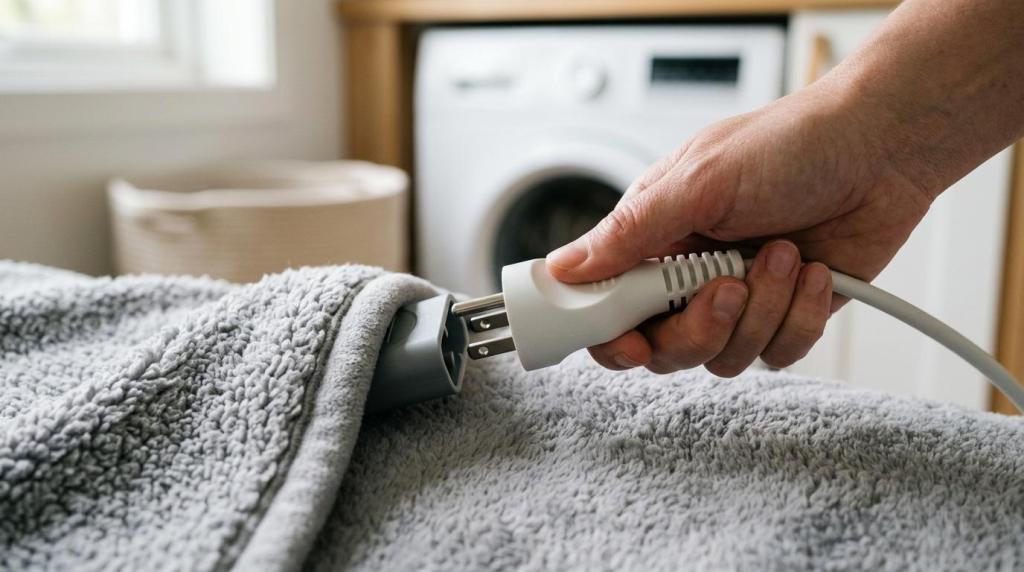
If the blanket is machine washable, always remove the controller before washing. A gentle programme and moderate temperature are common requirements. Many instructions set the maximum temperature at 30 or 40 degrees. Strong spinning, bleach and dry cleaning are generally prohibited.
Mistakes are surprisingly common when drying. Tumble drying is not usually part of electric blanket care, because heat and mechanical stress can damage the internal wires. Lay the blanket flat to dry and allow it to dry completely before using or storing it again.
A good rule of thumb is this: if the washing instructions on the product page are unclear, the blanket is already a less suitable option in terms of care.
Remember these washing and care steps:
- Remove the controller and power cord
- Check the permitted washing temperature
- Use a gentle wash and mild detergent
- Do not tumble dry
- Dry completely before use
- Store loosely folded without sharp creases
Storage affects service life more than many people realise. If the blanket is compressed into a small box or tightly folded in the same places every time, the wire network is put under strain. Loose rolling or light folding is generally safer if permitted by the instructions for use.
Electric blanket 150x180 materials and even warmth
An electric blanket does not feel warm simply because electricity runs through it. The surface material, amount of filling and placement of the wires also affect how warmth feels against the skin. This is why two blankets with the same power can perform very differently.
Soft, thicker surfaces often give a more pleasant impression because heat does not escape immediately into the surroundings. In a thin blanket, heat may rise quickly, but the user can feel the wire lines more easily. This is one reason why it is worth reading product reviews specifically for comments on even heat distribution.
Heat distribution can be assessed by these signs:
- the wires are not clearly felt through the blanket
- the blanket warms up in several areas at the same time
- no hot spots form
- a medium setting is sufficient for normal use
If the aim is only general extra warmth in a cool bedroom, an electric blanket is not always the only solution. A substantial regular duvet, breathable bamboo, microgel or down filling may be perfectly sufficient without electricity. This is worth bearing in mind if easy washing, lightness or year-round use take priority over electric heating.
What to check on the product page when comparing 150x180 electric blankets
In an online store, a good product page saves a great deal of effort. If the information remains too general, buyers have to guess about matters that have a major impact on safety and everyday use. A simple mention of “warm and soft” is not enough.
First look at the dimensions, power, number of heat settings and automatic shut-off details. Then check whether the controller is detachable and whether the care instructions are described precisely. If no mention of washing can be found, it is worth being cautious. The same applies to safety features: if they are not clearly stated, comparison remains incomplete.
It is worth looking in product reviews for answers to highly practical questions. Does the blanket heat up quickly? Does it feel equally warm all over? Is the controller easy to use? Does the fabric remain neat after washing? These are the comments that reveal how the blanket feels in real life.
A good buying checklist can be surprisingly short:
- Size and intended use: sofa, bed or both
- Power and adjustment: whether low settings are sufficient for prolonged use
- Safety features: shut-off, thermostat, clear instructions
- Washing: machine washable or surface-cleaning only
- Material: soft surface or a thinner, lighter construction
If the product page answers these points clearly, you are already well on your way. The choice is then based not only on wattage or sale price, but on how well the blanket suits your own use, home and way of sleeping or relaxing.
