Cooling duvet – the best materials and sizes for different sleepers
Many people only start looking for a lighter, fresher duvet when their sleep is disrupted by sweating, feeling too warm or constantly kicking the duvet off. At that point, attention often turns to room temperature, even though the duvet’s material, size and construction have a surprisingly large effect on how the bed feels during the night.
The purpose of a cooler duvet is not to make sleeping cold. It is designed to help the body release heat more evenly, move moisture away from the skin and reduce stuffiness. When a duvet breathes well, you stay drier and it is easier to sleep more peacefully.
Who is a cooling duvet best suited for
A cooler duvet is often seen as a summer-only product, but in practice it suits many people all year round. For hot sleepers in particular, the right duvet can be as important as a suitable mattress or pillow. If you wake up sweaty at night, change position often or sleep with a leg outside the duvet to cool down, it is worth taking a closer look at the duvet’s temperature regulation.
The need is not always related to the season alone. Some people naturally sleep warm even in winter, while others experience night sweats due to life circumstances, hormonal changes, stress or medication. In these cases, a duvet that is too dense or heavy can make the problem worse, even if the room is not particularly warm.
A cooling duvet is often a good choice when a more even temperature feel is desired. Many people do not feel cold when falling asleep, but start to get too warm during the night.
If you recognise yourself in any of these groups, a cooler duvet may be a practical solution:
- Sweaty sleeper: bamboo viscose, linen or lyocell are often comfortable because they transfer moisture effectively.
- Sensitive-skinned sleeper: smooth lyocell, soft cotton and many allergy-friendly options feel gentle on the skin.
- Someone who feels cold but gets warm during the night: light layering in bed often works better than one very warm duvet.
- Couples with different temperature preferences: a larger duvet or two separate duvets reduces nighttime adjustments.
The best materials for a cooling duvet
Material makes a big difference. Not all lightweight duvets feel cool, and not every thicker duvet is automatically stuffy. What matters is how the cover fabric breathes, how the filling handles moisture and how the construction allows air to circulate.
Cotton is a safe and familiar choice. It breathes well and feels comfortable to most people, but it has one clear characteristic: it absorbs moisture. If sweating is heavy, a cotton duvet may feel damp or heavy towards morning. However, in a lightweight percale weave, cotton works excellently for many people because the surface remains airy and fresh.
A bamboo-feel duvet emphasises a soft surface, moisture management and often allergy-friendly properties as well. This is why they are popular with hot sleepers and people prone to night sweats. Linen, on the other hand, is very airy and dries quickly, making it a strong choice for summer. It feels firmer at first than cotton, but many people feel that this is exactly what makes it pleasantly cool for sleeping.
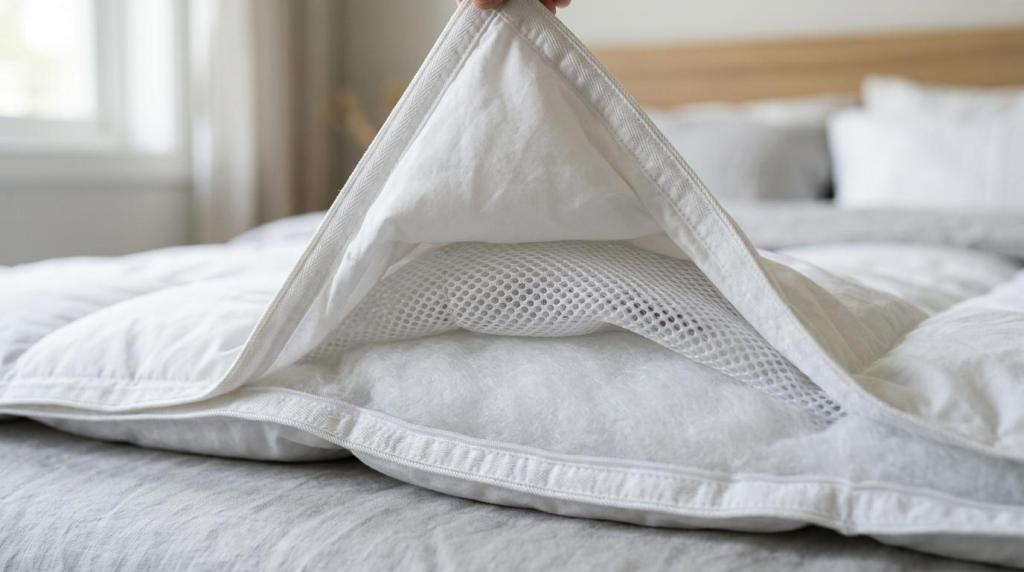
Synthetic material is not automatically a poor option. Standard dense polyester can retain heat, but the situation is different with developed fibres and constructions. Microfibre, hollow fibre and 3D air channelling can increase air circulation and help manage moisture. This is why many duvets described as cool combine a soft surface with a technical construction.
|
Material |
Breathability |
Moisture management |
Feel against the skin |
Suitable for |
|---|---|---|---|---|
|
Cotton |
Good |
Moderate, absorbs moisture |
Soft, familiar |
General use, those looking for a lightweight duvet |
|
Bamboo viscose |
Very good |
Very good |
Smooth, cool feel |
Hot sleepers, sensitive skin |
|
Linen |
Excellent |
Good, dries quickly |
Firm, airy |
Summer, very warm bedrooms |
|
Lyocell/Tencel |
Very good |
Very good |
Smooth and lightweight |
Sweaty sleepers and those sensitive to moisture |
|
Microfibre / technical polyester |
Varies by construction |
Good in the best constructions |
Lightweight, often soft |
When easy care and an airy construction are desired |
The material name alone does not tell the whole story. If the product information mentions 3D Air, a mesh-like layer, hollow-fibre filling or special moisture regulation, it often means that coolness is achieved through the construction, not only through the fibre name.
Cooling duvet sizes for different sleepers
Size affects coolness more than many people realise. A duvet that is too small leaves the legs, shoulders or side exposed, meaning you need to adjust your position constantly. A duvet that is too large, on the other hand, can gather in folds, causing the fabric to fold over itself and air to remain still and warm up.
For a single sleeper, a standard 140 x 200 cm is often sufficient if you are not particularly tall and do not move much during the night. For a tall sleeper, 140 x 220 cm is often a more sensible choice, as the toes stay under the duvet without having to pull it too far up. Common sizes for couples are 200 x 200 cm and 200 x 220 cm, but sleepers who move a lot may benefit from an even wider 240 x 220 cm size.
Side sleepers, people who change position and those who move their duvet around usually need more width than sleepers who stay still on their backs. This also relates to an important practical rule: a cooling duvet works best when it provides good coverage without creating too much excess bulk around the body.
|
Duvet size |
Usually suitable for |
Note |
|---|---|---|
|
140 x 200 cm |
One average-height sleeper |
Works well in a narrow bed |
|
140 x 220 cm |
One tall sleeper |
Provides extra coverage at the foot end |
|
200 x 200 cm |
Two people or one person wanting extra room |
A balanced size for a shared duvet |
|
200 x 220 cm |
Two people when extra length is needed |
Good for people with long legs |
|
240 x 220 cm |
A wide bed or sleepers who move a lot |
Provides plenty of coverage, but may be overly generous in a small bed |
When choosing a size, consider both the mattress dimensions and your own sleeping habits, rather than only the size that feels most familiar.
Cooling duvets and sleep quality
A cooler sleep environment supports falling asleep because body temperature naturally drops towards the evening. When the duvet does not prevent this, it is easier to relax. Studies have found that cooling bed materials can reduce the time it takes to fall asleep and increase total sleep duration, especially for hot sleepers.
In one study involving adult hot sleepers, cooling sheets halved the average time to fall asleep from around 28 minutes to 14 minutes and extended nightly sleep by an average of around 26 minutes. In another study conducted in an overheated bedroom, active bed cooling increased sleep by around 19 minutes and reduced the time to fall asleep by around 10 minutes. The effects may not be dramatic for everyone, but they are practically significant if sleep is disrupted by heat almost every night.
The strongest benefit is often reflected in how sleep feels. Waking up becomes less frequent, the stuffy feeling in the morning eases and there is no need to negotiate with the duvet all night.
Studies have not provided equally clear evidence that a cooler duvet systematically changes sleep stages, such as the proportion of deep sleep. However, many people experience a clear improvement in subjective sleep quality. This is important because comfort is not a minor detail in sleep, but part of effective rest.
How product information helps you choose the right duvet
When comparing duvets online, it is easy to focus only on words such as "cool", "summer" or "breathable". They are useful, but it is even more useful to read the smaller details. These reveal what actually creates the coolness.
A good example can be found in current market options. Some duvets aim for a fresh feel with a bamboo-like, smooth surface. Others are based on a 3D Air construction duvet, designed to allow air to circulate more actively. Others are simply lightweight percale duvets for summer use. All of these can suit different people, even if they are marketed under the same theme.
Check at least the following in the product information:
- filling weight in g/m²
- cover fabric material
- warmth rating
- care instructions
- available sizes
- information on allergy-friendly properties
When ranges include both bamboo-feel models and 3D air-channelled options, it is worth considering the difference in relation to your own needs. If feel against the skin is most important, a smooth, moisture-wicking surface may feel best. If the problem is specifically heat trapped under the duvet, a model that emphasises construction may work better.
Many people benefit from this simple division:
- For summer use: a lightweight duvet, airy fabric, moderate filling weight.
- For year-round use: warmth rating 2 or a similarly balanced solution.
- For sensitive sleepers: an anti-allergenic and easily washable material.
- For those who move a lot: sufficient width so the duvet stays with you when changing position.
Practical examples of cool duvet solutions
Current ranges clearly show that coolness can be achieved in many ways. A bamboo-feel duvet emphasises a soft surface, moisture management and often allergy-friendly properties as well. This type suits someone who wants, above all, a pleasant feel and a more even temperature from their duvet.
A 3D Air construction duvet, on the other hand, is based more on air circulation. The idea is that a warm, stagnant layer of air does not form as easily inside the duvet. This type of construction may work particularly well if a standard microfibre duvet feels too stuffy, even if it is not heavy.
A lightweight percale duvet is often a very straightforward solution for summer. It may not include technical features, but it feels airy and easy to use on warm nights. If the bedroom is already cool and night sweats are not severe, lightweight percale can be perfectly sufficient.
How the rest of your bedding setup affects the performance of a cooling duvet
A duvet does not work alone. If there is a heat-retaining mattress protector underneath, dense polyester sheets on top and stagnant air in the bedroom, changing the duvet alone will not solve everything. A cooling duvet performs best when the sheets also breathe and the room is at a moderate temperature.
This is why a good combination is often a lightweight duvet and breathable sheets, such as percale cotton, linen or lyocell. When both the duvet and the sheet transfer moisture, the skin stays drier and the bed feels more even throughout the night. This is usually reflected in waking up less often and the duvet staying on more naturally.
If your sleep feels hot only during part of the year, the solution may be as simple as a separate summer duvet and a slightly warmer option for winter. One duvet rarely feels perfect in both heatwaves and freezing weather, even though year-round models work well for many people. When the duvet size, material and season match, nighttime temperature regulation becomes clearly easier.
