When should a baby have a duvet and pillow?
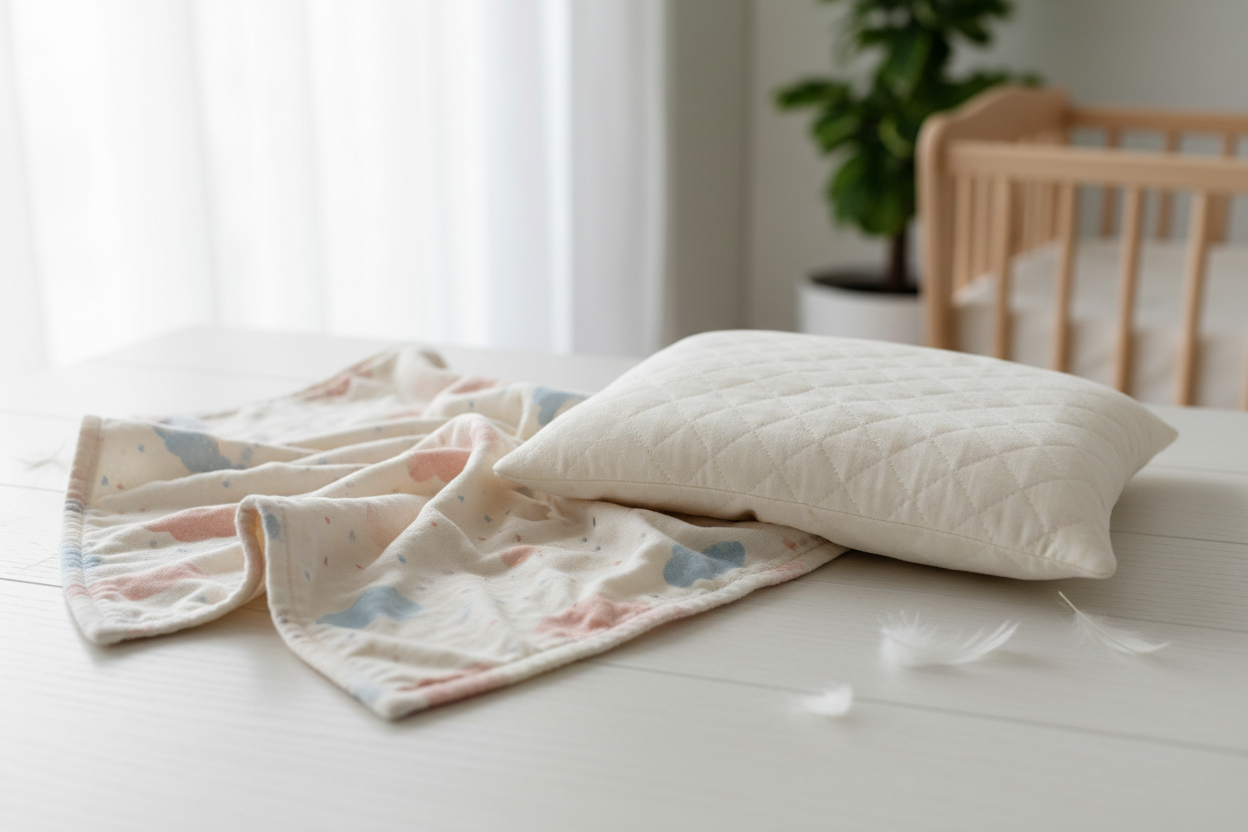
When choosing sleep essentials for a baby, two questions quickly arise: when is a blanket safe, and does a baby need a pillow at all? The answer is not simply a matter of preference, but is directly related to safe sleep, unobstructed breathing and avoiding overheating.
Many people are surprised by how long the recommendation is to keep the bed “empty”. Even so, it is entirely possible to keep a baby warm in everyday life without loose textiles when the right choices are made.
Why are a blanket and pillow different for a baby than for an adult?
A newborn and young baby do not yet control their body movements in the same way as an older child. If a blanket or pillow moves over the face, the baby may not be able to move it away. Soft and loose bedding can also retain too much heat and increase the risk of overheating.
International safe sleep guidance (maternity clinic guidelines, THL principles for a safe sleeping environment, and international organisations such as the AAP and The Lullaby Trust) repeats the same core message: a baby's sleeping space should be firm and bare, without loose textiles.
This does not mean that the baby should be cold. It means that warmth should primarily be provided through clothing and safe solutions designed for this purpose.
When can a baby use a blanket?
A general and clear guideline is: preferably no loose blanket during the first year of life. In many guidelines, a blanket is considered safer only after 12 months, and even then it should be lightweight.
If a family is considering a blanket closer to the age of 1, the situation is crucial: mobility, the temperature of the environment, the sleeping space and whether the blanket will definitely stay away from the face. For a young baby, the safest option is a sleeping bag, as it cannot rise over the head.
If a blanket is introduced in toddlerhood, choose a lightweight and breathable material. A thick, bulky or easily rolled-up blanket is not the best first option.
Many guidelines use a “feet to foot of the bed” approach with a blanket: the baby is placed at the bottom of the bed and the blanket is tucked in firmly at the bottom so that it cannot ride up. This is still a compromise compared with a sleeping bag.
When can a baby use a pillow?
A pillow is usually unnecessary for a baby for a long time, and many guidelines do not recommend one at all for children under 1 year old. Several expert guidelines postpone consideration of a pillow until 18–24 months of age, while some recommend avoiding pillows for children under 2.
The reasons are practical:
- a baby's neck and head rest naturally on the mattress without elevation
- a pillow is an extra soft item in the bed
- a thick pillow can position the head at an unfavourable angle or retain heat
When a pillow is eventually introduced, it should be a very low children's pillow, not an adult pillow in a smaller pillowcase.
A one-sentence rule of thumb: the younger the child, the less there should be in the bed.
By age group: a quick table for everyday guidance
|
Age |
Blanket |
Pillow |
Safer basic option |
|---|---|---|---|
|
0–6 months |
Not recommended |
No |
Sleeping bag or suitable layers of clothing, firm mattress, fitted sheet only |
|
6–12 months |
Still preferably no |
No |
Sleeping bag, suitable room temperature, additional clothing layer if needed |
|
12–18 months |
Consider a lightweight blanket |
Often not yet |
Lightweight, breathable blanket or sleeping bag if the child accepts it |
|
18–24 months |
Often okay if lightweight |
Consider a low children's pillow |
A quality blanket sized for toddlers, a very low pillow if the child clearly benefits from it |
|
2+ years |
Generally okay |
Generally okay (children's model) |
Children's bedding: the right size, easy to wash, breathable materials |
The table is indicative. If the child has medical conditions, reflux or breathing-related special considerations, it is sensible to ask a maternity clinic for individual guidance.
Warmth without a blanket: a practical formula
A blanket is often missed because the baby kicks it off and seems cool. A sleeping bag solves this for many: it stays on and does not gather around the face.
It is also worth paying attention to room temperature and whether the baby's clothing is suitable. Dressing a baby too warmly can be just as problematic as being cold, because overheating is not always obvious to an adult.
A good practical check is to feel the baby's neck or chest: it should feel warm, not sweaty. Hands and feet may be cooler than the torso.
When choosing a sleeping bag or nightwear, consider these basics.
- Room temperature: a range of approximately 18–20 °C suits many, but homes vary.
- Materials: cotton, bamboo viscose and other breathable options often work well.
- Fit: the neckline and armholes should fit snugly so that the baby cannot “slip down” inside the bag.
If a blanket is introduced after all: selection criteria
When the child is at an age and skill level where a blanket can be considered, it is worth keeping the choice practical and safe. A lightweight blanket is often a better starting point than a bulky one.
The following features make use easier and reduce risks.
- Breathability: thin cotton or a lightweight weave that does not form a dense “wall” over the face.
- Lightweight construction: the child can move the blanket away from their face themselves.
- Easy care: frequent washing is possible and the filling does not clump.
Decorative tassels, cords or detachable embellishments are best reserved for older children. For baby and toddler textiles, simple is often best.
A pillow for a toddler: how do you know it might be time?
Some children sleep for years without a pillow, and that is not a problem. A pillow is sometimes wanted when a child moves to a children's bed, seeks to sleep on their side and tries to find cushioning for under their head.
The signs are not a “mandatory list”, but everyday observations: does the child get up at night to place a blanket under their head, constantly wriggle to find a position, or sleep peacefully without support?
If an adaptable pillow is introduced, prioritise a low profile. An adult pillow is often too high for a toddler, and the head may tilt forward.
Safe sleep basics when considering bedding
Although a blanket and pillow raise the most questions, safe sleep is built from several small elements. When these are in place, there is less need to “fix” sleep with extra padding.
The most important principles can be summarised in a short checklist:
- Sleep on the back: always place the baby on their back to fall asleep.
- Firm mattress and tight-fitting sheet: no soft surfaces, no loose protectors.
- Keep the bed empty: no pillows, blankets, soft toys or cot bumpers during the first year.
If any point feels contradictory to your everyday life or previous traditions, a maternity clinic is the right place to seek reassurance. The purpose of the guidelines is not to add stress, but to reduce risks when a baby is most vulnerable.
Materials and certifications: what is worth knowing?
Textiles that come into contact with a baby's skin are in constant use and often need washing. This is why material and chemical safety matters, even if the blanket or pillow itself is not yet in use.
OEKO-TEX-type certifications help identify products with limited harmful residues. This does not automatically make a product “the right one”, but it is useful starting information when comparing options.
Practical services also have value: a baby's size and the season can be surprising, and sometimes the right size is only found through trying. Finnish online shops such as Finnmart.eu now often offer flexible return rights, insured deliveries and easily accessible customer service through messaging channels, which makes purchases easier when everyday life is busy.
A short checklist before adding anything to the bed
When you feel like adding a blanket or pillow “just in case”, pause for a moment and first check the room temperature, the baby's clothing, the size and fit of the sleeping bag, and whether the bed already has everything essential.
At this point, many people realise that the issue was not a lack of a blanket, but a bedroom that was too cool, nightwear of the wrong thickness or a sleeping bag that had become too small. When the basics are addressed, sleep often settles without loose bedding.
