Blackout curtains for the bedroom – a guide to light blocking and sizing
Bedroom lighting conditions have a surprisingly significant impact on how sleep feels. Many notice the difference immediately in summer, when morning light wakes them too early, or when a building complex's courtyard light shines directly into the window. At that point, an ordinary curtain is no longer enough; a genuinely light-blocking solution is needed.
A blackout curtain is not just a decorative element. It is also a practical way to calm the room, reduce light leakage and make the sleeping environment more consistent throughout the year. When the material, sizing and installation are right, the bedroom can become noticeably more restful.
Why blackout curtains improve sleep in the bedroom
Darkness supports the body's natural circadian rhythm. Even relatively little light can disrupt melatonin secretion and delay falling asleep. In everyday life, this can easily result in lighter sleep, more frequent waking at night or feeling tired in the morning despite having slept enough hours.
For this reason, blackout curtains are useful at many times besides midsummer. They help shift workers, families with children who nap during the day and urban homes where streetlights, advertising lights or neighbours' lighting enter the bedroom. Many people simply want the calmest possible space without starting the morning on the light's terms.
A blackout curtain often also affects the atmosphere of the room. When the window is not glowing with incoming light, the bedroom feels softer and more enclosed. A thicker fabric can also slightly dampen sound and help keep the room cooler in hot weather and warmer in freezing conditions.
Blackout curtain materials and light-blocking ability
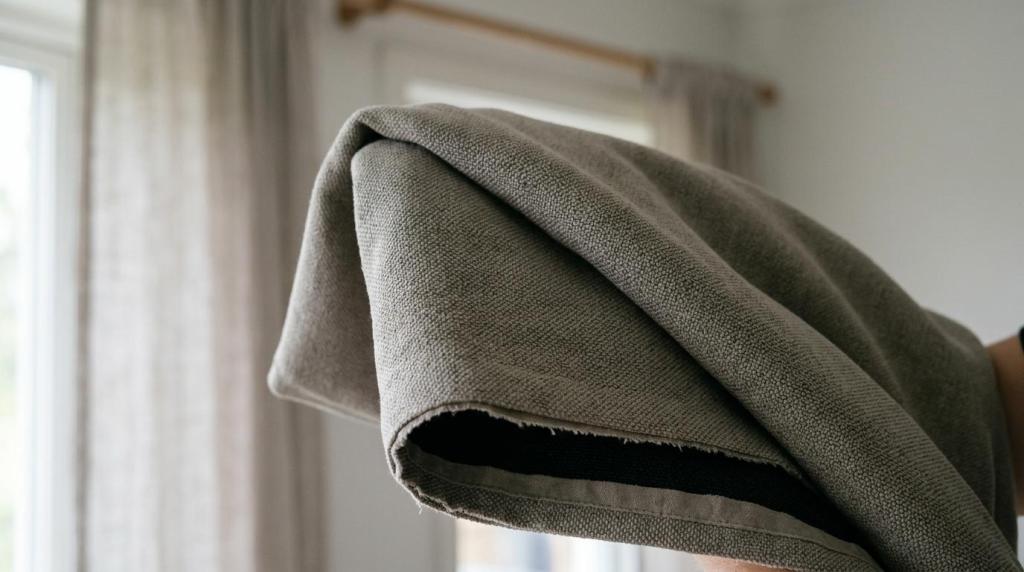
Not all dark curtains are blackout curtains. This is a common misconception. A curtain may be black or dark grey, but if the fabric is thin, light will still pass through it quite easily. Effective blackout performance comes primarily from the structure of the fabric.
Effective blackout curtains often use tightly woven polyester, a multi-layer construction or a separate blackout lining. Thick velvet and wool-like fabrics can also block light well, but their practicality depends on the room, weight and care instructions. If your aim is the darkest possible bedroom, it is worth checking whether the curtain is genuinely blackout-style rather than simply dimming light.
|
Material or construction |
Light blocking |
Benefits |
Things to consider |
|---|---|---|---|
|
Triple-weave polyester |
very good, often 95–99 % |
effective blackout performance, easy care, good value for money |
appearance may be more technical than natural fibres |
|
Curtain with blackout lining |
very good |
combines a decorative outer fabric with effective light blocking |
heavier, requires careful sizing |
|
Thick velvet |
good or very good |
soft look, sound dampening, luxurious feel |
may collect dust and require more space |
|
Thin cotton or linen without lining |
poor |
light and airy look |
not sufficient for true blackout performance |
In addition to the material, the result is affected by how the curtain sits around the window. If gaps remain at the sides, top edge or centre of the curtain, light quickly finds its way in. Good blackout performance is therefore always a combination of the right fabric and the right installation.
These factors have the greatest effect on light blocking:
- Fabric construction: a dense weave and multiple layers block light better than thin, single-layer fabric
- Installation height: the rod or track should be installed above the window, not directly level with the frame
- Side overlap: curtains should extend well beyond the edges of the window
- Amount of pleating: a curtain that is too narrow pulls flat and begins to leak light at the edges
- Centre seam and gap between panels
- Window recess
- Nearby radiator or window handle
Sizing blackout curtains for a bedroom window
Good sizing makes a surprisingly big difference. Even if the fabric is high quality, a curtain that is too narrow or too short lets light in precisely where you most want to block it.
It is worth measuring carefully and noting the measurements down on paper. This will help you avoid a curtain that looks good in an online store product photo but turns out to be too small in your own bedroom.
Measure at least the following:
- window width
- window height
- distance from above the window to the desired position of the rod or track
- free space on both sides of the window
- location of the floor, radiator and window handles
The right width for blackout curtains
As a rule of thumb, a blackout curtain should not be the same width as the window. The curtain needs to cover the window opening and extend beyond it. A commonly effective solution is to add approximately 15–30 centimetres on each side. With sufficient side overlap, light cannot escape in as easily.
Width is also needed for pleats. If the curtain hangs completely flat, it looks stiff and does not block light as effectively as possible. Many choose a total width of around 1.5–2.5 times the width of the rod, depending on whether a more restrained or fuller pleated look is desired.
If the window is 120 cm wide, a good overall solution could be, for example, 180–240 cm of curtain fabric divided into two side curtains. This allows the curtains to cover the window properly, move neatly and look finished when drawn open as well.
The right length for blackout curtains
In a bedroom, the most popular option is generally a floor-length blackout curtain. It looks finished and also helps block light from the direction of the lower edge of the window. If the aim is a clean, calm look, the length should be measured so that the curtain just brushes the floor or falls very slightly above it.
The position of the rod or track greatly affects how tall the room looks. When the hanging point is raised approximately 15–20 centimetres above the window, the window appears taller and light leakage at the top edge is reduced. At the same time, the curtain becomes more practical.
If there is a radiator or furniture beneath the window, a full-length curtain is not always the best option. In that case, the length can end below the windowsill or above the radiator, as long as the fabric covers the glass itself and extends slightly beyond it. Blackout performance is still often better when the curtain extends at least clearly below the lower edge of the window.
Curtain rod or track for blackout curtains
The hanging method affects both appearance and light blocking. A curtain rod is an easy and familiar choice for many, but the curtain may sit slightly further away from the wall. This can increase light leakage at the top and sides if the rod projects outward and the curtain does not sit snugly.
A track, in turn, often produces a neater and more closely fitting result, especially if installed close to the ceiling. On a track, the curtain moves smoothly, falls straight and can close the window very precisely. If the aim in the bedroom is the most effective possible blackout performance, a track is often an excellent option.
The curtain style also matters. A ring-top curtain is quick to hang, but a hook-fastened curtain can provide more control over height and pleating. When the aim is a dark room, even small details show in the final result.
Colours and style in bedroom blackout curtains
A blackout curtain can be practical without looking heavy. Many shades are available for the bedroom that soften the space without making the room feel cramped. Light greige, sand, warm grey, muted blue and deep green often work well when a calm atmosphere is desired.
A dark curtain does not automatically block light better than a light one. The decisive factor is the fabric's blackout construction. This means even a light-coloured blackout curtain can work excellently in a bedroom. This is especially good news for small rooms, where very dark textiles can feel overpowering.
If you prefer a layered interior, you can combine a blackout curtain with a lighter side curtain or sheer curtain. During the day, the room can have soft light, and in the evening the thicker curtain is drawn closed. This also works well when you want privacy from the window without continuous darkness.
A good combination choice often depends on what you want from the bedroom:
- Calm look: solid-coloured, matte fabric
- Hotel-style atmosphere: long, full pleats and floor-length curtains
- Small bedroom: a lighter shade and hanging raised to the ceiling
- Shift worker's room: the most closely fitting blackout fabric possible and a track solution
Practicality, care and everyday comfort in blackout curtains
Bedroom curtains are used daily, so ease of care is worth considering at the time of purchase. Polyester-based blackout curtains are often practical because they withstand use well, crease less and are frequently machine washable according to the care instructions. The washing method should always be checked for the individual product, however.
Useful everyday features also include fabric weight, dust accumulation and how easily the curtain slides on the rod or track. If the curtain catches every morning, you will not use it as readily. In the bedroom, functionality quickly shows in whether the curtain actually stays closed when it should.
Many also value safe, high-quality materials. Certified textiles provide reassurance that a curtain is well suited to everyday home use, especially when the product is close to the sleeping environment.
For example, HemmingsenKids explains in practical terms what the ÖKO-TEX label means for children's products and why tested dyes and emission limits are essential for bedroom textiles.
The same applies to durability: a good blackout curtain is a purchase you hope will remain neat for a long time.
The most common mistakes when choosing blackout curtains
Most problems are not caused by the curtain itself, but by sizing. A common situation is choosing a curtain as wide as the window and installing the rod exactly at the frame. The result is that light enters from the sides, above and sometimes even below. The curtain is therefore blackout, but the overall setup is not.
Another common mistake is confusing a dimming curtain with a blackout curtain. Dimming fabric can be good for a living room or a space where you only want softer light. In a bedroom, it is not always enough if the aim is a genuinely dark room.
Mistakes that quickly become apparent in use:
- Curtain too narrow: light leaks in from the sides first thing in the morning
- Curtain too short: a bright strip remains at the bottom
- Incorrect hanging height: the top edge is left open
- Choosing a dark colour without blackout construction
- Focusing on appearance alone
- Forgetting the care instructions
When selecting blackout curtains for the bedroom carefully, focus on three things: material, sizing and installation. When these are balanced, the curtain not only looks good but does exactly what it is expected to do: guide the room's light, atmosphere and sleep in the right direction.
